
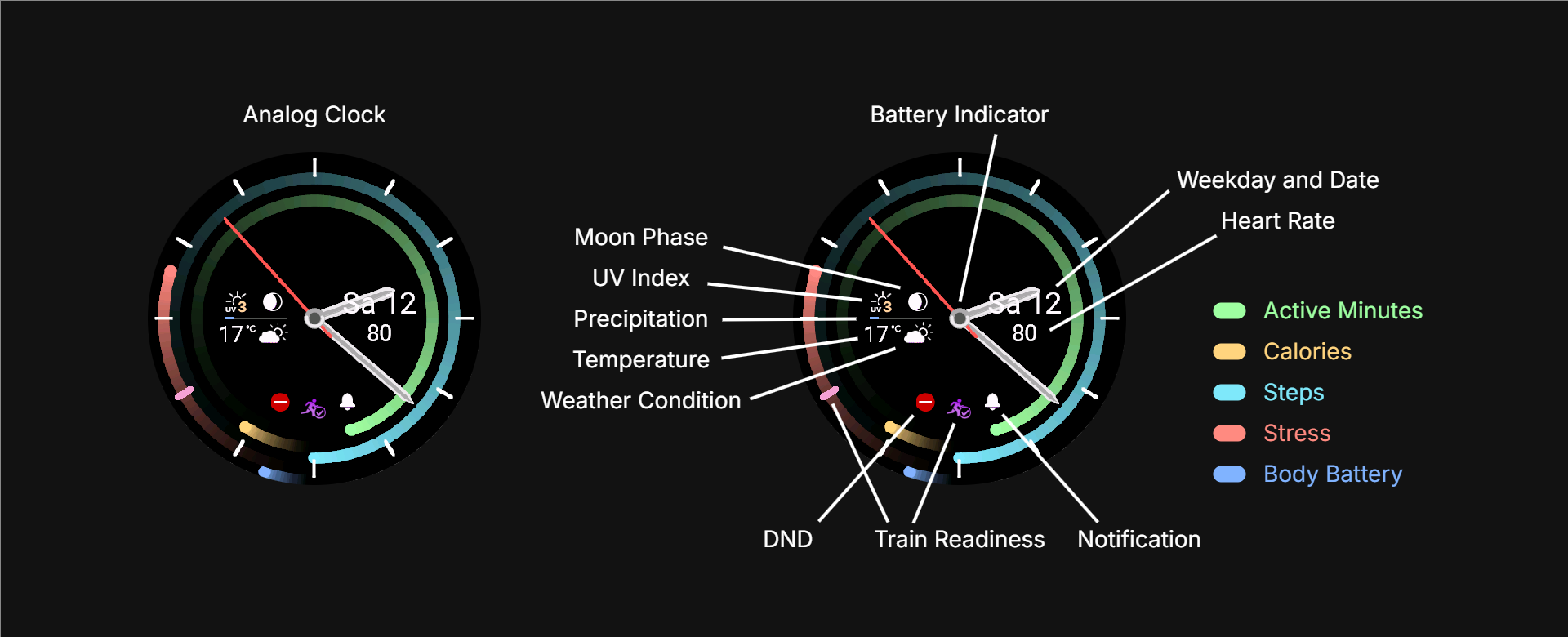
Developing for wearables like Garmin watches is a unique engineering challenge. Unlike mobile or web development, you're working with strictly limited memory, processing power and a battery that users expect to last for days, not hours. Every CPU cycle and every byte of memory counts. This environment forces a return to foundational principles: a performance-first architecture, disciplined memory management and relentless optimization. The Aion watch face is a project born from these constraints, aiming to deliver a feature-rich experience without compromising the core user expectations of a modern smartwatch.
Aion is a modern, data-centric analog watch face for Garmin devices. At its heart, it's designed to provide a clean, at-a-glance view of both time and a wide array of health and weather metrics. The design philosophy was to blend a classic analog aesthetic with the powerful data-tracking capabilities of Garmin watches, creating something that is both beautiful and functional. It serves not just as a timepiece, but as a personal dashboard for your day. You can download
Aion
from the Connect IQ Store.The visual centerpiece of Aion is its set of five concentric arcs that track daily progress for Body Battery, Stress, Steps, Calories and Active Minutes. This provides a quick, intuitive way to see how you're tracking against your goals. Surrounding this are dedicated data fields for date, heart rate (color-coded to your personal zones), local temperature, weather conditions, moon phase, and even the chance of precipitation. Status icons for DND, notifications and training readiness are tucked away neatly, ensuring a clean yet informative display.
But Aion goes beyond just displaying data, it makes it personal and actionable. It features a dynamic daily calorie goal calculated from your Basal Metabolic Rate (BMR) and activity level, providing a scientifically-backed target. Similarly, your daily active minutes goal is intelligently derived from your weekly target in Garmin Connect. With features like AMOLED screen protection and a battery indicator arc, every detail is geared towards a seamless and intelligent user experience.
One of the most significant learnings from building Aion was the critical importance of a performance-first architecture. The key to its smooth operation lies in pre-rendering. On startup, all static elements of the dial, the tick marks, numbers and decorative rings, are drawn once into an off-screen bitmap buffer. In the main `onUpdate` loop, which runs every second when active, the watch face only needs to draw this pre-rendered buffer and the dynamic elements (like the watch hands). This dramatically reduces the drawing workload, leading to a massive improvement in performance and battery life.
To manage the constant stream of sensor data, Aion implements a strict unidirectional data flow. A central `DataManager` module is solely responsible for fetching, caching and processing all data from Garmin's APIs. This data is then stored in a global state module. The various drawing components only ever read from this global state; they never write to it. This pattern simplifies state management, eliminates potential race conditions and keeps the rendering logic clean and focused on one job: drawing.
On a watch, battery life is not just a feature, it's the feature. Aion employs several strategies to maximize it. The most obvious is hiding the battery-hungry second hand when the watch enters its low-power sleep mode. The app also hooks into the `onEnterSleep` and `onExitSleep` system events to disable any high-frequency updates or timers. Furthermore, all data is aggressively cached with intelligent expiration times, preventing the watch from waking up the CPU or sensors for redundant fetches.
The project was a lesson in how to make data truly meaningful. Instead of showing a generic calorie count, Aion calculates a personalized Total Daily Energy Expenditure (TDEE) goal using the Mifflin-St Jeor formula combined with the user's profile data (age, gender, weight, height) and activity class from Garmin Connect. Similarly, heart rate data isn't just a number, it's color-coded based on the user's actual heart rate zones. This level of personalization turns the watch from a passive data collector into an active, insightful companion.
Building the Aion watch face was a deep dive into the world of embedded and resource-constrained development. It reinforced the idea that for wearables, a robust architecture and a relentless focus on optimization are not just best practices, they are absolute requirements. Aion stands as a case study in balancing a rich feature set with the performance and battery life that users demand, offering key lessons for anyone looking to develop for the Garmin ecosystem.